
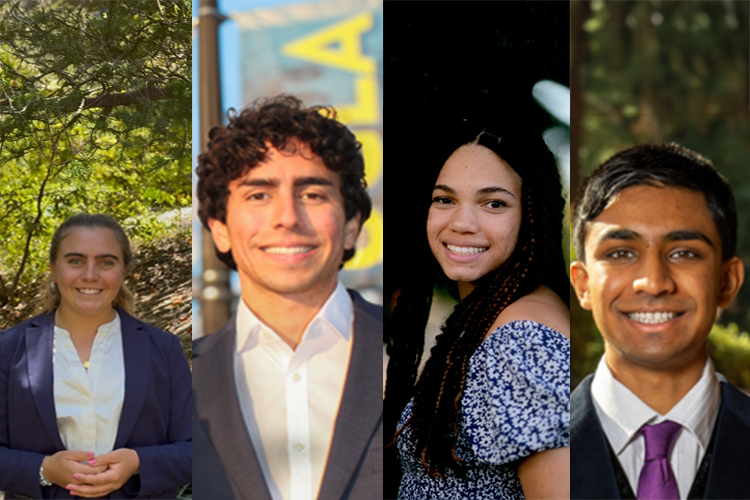
This summer we had the opportunity to interview the winners of last year’s SGUO Case Competition on “Antibiotic Resistance, its Implications, and Potential Solutions“, Claire Koerber, David Singley, Devyn Betts and Sushant Bhopale.
Their project focused on increasing awareness of antibiotic resistance among farmworkers. They created an interactive online website with a focus on providing information in a digestible, straightforward manner. The website’s content centered on sustainable farming practices, personal health habits, and the dangers of antibiotic resistance. For example, the website had an interactive flowchart with step-by-step instructions for how to maintain personal safety during various activities of the typical workday. Each step of the flowchart had audio translations, and the website and audio were available in English and Spanish. The website also had a short questionnaire to gauge if the user was having symptoms of an infection; if symptoms were present, the user would be directed to a page with resources to contact a physician or make a medical appointment.
1. What steps did you take to learn more about your case?
Claire Koerber: Following our initial team meeting, we decided to research possible subtopics related to antibiotic resistance. I started off by doing some background research on the issues caused by antibiotic resistance and eventually delved into some of the contributors to antibiotic resistant bacteria, including the use of antibiotics in agriculture.
Sushant Bhopale: I researched topics on my own that seemed to be unique niches within antibiotic resistance. I found the research on fitness tradeoffs highly interesting, as much of the discourse surrounding antibiotic resistance does not usually delve into how microorganisms may be disadvantaged in some ways when they acquire resistance. I initially presented this idea to the group, and although we found the topic interesting, we did not think this topic had enough social implications to be a viable choice for our project.
David Singley: I compiled a list of research papers for a general literature review. Using meetings each of our notes and insights, we used meeting time to ask questions we still did not understand which helped us shape the focus of our case work.
Devyn Betts: To effectively build our case, I first compiled research papers related to antibiotic resistance, focusing on those that specifically addressed topics not commonly discussed in the classroom. Each of us did this and met periodically to discuss our findings. We also consulted our faculty advisor to narrow our research interest into a solidified topic, ready to execute through our platform and video.
2. What was the hardest part of the competition, and how did you deal with it?
Claire Koerber: It was difficult for our team to choose the best angle to address issue of antibiotic resistance. We narrowed our research down to antibiotic resistance in agricultural communities and research in antibiotic resistant tradeoffs, but we were finding it difficult to piece together all of the information we had gathered to form an effective solution for the project. Ultimately, with the help of our faculty advisor, Dr. Allard, and discussions between our team, we settled on antibiotic resistance awareness amongst agricultural communities in California.
Sushant Bhopale: Identifying and sticking to a topic was the hardest part. We all had a lot of interesting ideas, and it was initially difficult to settle on a topic. For example, we had decided about halfway through the project to focus on the fitness tradeoffs of resistant microorganisms, but after discussing with Professor Allard, we decided that this topic would not give us the specificity and interdisciplinarity that we would need. We switched to focusing on agricultural workers, another topic we had been considering at the start of our project, as a result.
David Singley: To add, we wanted to be specific enough to actually highlight a path for change with viable steps and possible outcomes. Despite our passion for this project, we knew that any problem as dynamic as antibiotic resistance cannot be solved all at once around the world, but rather with small action plans to help each vulnerable community.
Devyn Betts: One of the hardest parts was narrowing our topic to a specific issue. It helped to meet with our faculty mentor Dr. Allard for suggestions on next steps to take. Afterwards, I struggled with thinking of a tangible way to help resolve the issue and how to compile it into a video. After brainstorming, we first wanted to create a pamphlet, then began to tackle the issue of accessibility. With accessibility in mind, we changed the pamphlet to an online platform, then incorporated other details (such as having Spanish translations).
3. Did you use any special tools or sources to do your research?
Claire Koerber: It was helpful for the team to speak with Dr. Allard and compile a literature review to assess our options for the project.
Sushant Bhopale: I did not really use any special tools or sources. However, in our meeting with Dr. Allard, David mentioned that he was able to connect the topic to his personal experiences with family members in the agricultural industry.
David Singley: Personal passion and understanding of the community struggles helped give context when Dr. Allard introduced his current field of research regarding vulnerabilities within agricultural communities. However, resources as simple as google scholar and sites helped us to deeply understand both scientific and social considerations and ultimately, solidify our deliverable.
Devyn Betts: I used the UCLA Library database to find online resources. I also searched the internet for links or numbers to resources that we could feature on our website.
4. What advice would you give to future participants who want to stand out in a case
competition like SGUO’s?
Claire Koerber: Although there is a quick timeline for the project, do not rush when deciding how to focus and complete your project. It was helpful to brainstorm and talk with our advisor about possible routes we could take for our project. Once you’ve chosen your specific topic and audience, think about creative ways to present your solution and project. It is helpful to have a project that you can actually develop a prototype of as well because it makes for a great presentation visual. For example, we created a website with the resources we wanted to provide.
Sushant Bhopale: Come up with an idea for a solution as early as possible. Talk to your peer advisor and faculty advisor to make sure that you are on the right track, but once you settle on something, focus on making your solution robust and unique. One of the strengths of our project was that we were able to get into the specifics of how the website would be designed, such as Spanish translation for the text and audio modules for individuals who prefer listening to information. Choosing a solution earlier rather than later allows you to have the time to think of and implement these creative ideas.
David Singley: It also became so apparent that there is so much research and progress each student can make with the resources available to them through UCLA.
Devyn Betts: I would suggest that future participants really use thoughtful discussion as a method for solidifying a topic. When I researched on my own or read the research of my group members, it was effective but not very efficient. However, each time we met to discuss as a group or to discuss with our advisor, I found myself so much more well-versed on the topic at hand, and it made the overall process fun and interesting.